

How To Think Before You Move.

A friend wanted to open a café with his savings.
So he shared it with everyone. Asked for opinions, hacks, industry secrets.
My brother killed his entire business plan in less than 10 street-smart questions.
He’s been a salesman for years. So he knows exactly where enthusiastic, inexperienced solopreneurs get blindsided and burned, especially when they plan to run a whole storefront alone.
Dreams are fine. Ideas are sexy.
But execution decides whether your future grows or decays.
The questions weren’t out of this World. They were simple, forward-projection checks that tested reality instead of fantasies.
After every answer he’d counter-ask,
“Ok, so then what happens when that becomes the bottleneck?”
Ten minutes later, our friend was a bit crushed, but 100% clear.
.
2. Why This Matters?
You are probably not opening a café.
And you will probably never meet my brother (unlucky you, he is great).
Doesn’t matter. The point is: you can test the next step without burning time, money, sanity, or any other scarce, valuable resource you possess.
Mental simulations aren’t predictions. They are assumptions.
And assumptions are cheaper than real mistakes.
You don’t simulate to be right.
You simulate to avoid walking straight into an avoidable hit.
You simulate to see the cost before you pay it.
.
3. What Mental Simulations Actually Are
There are many ways to do it. Build your own. But two classics work instantly:
a. The Marathon Run
Marathoners walk the whole route before the race day.
Terrain. Turns. Elevation. Every tiny detail.
You won’t walk anything. But you can do the same mentally:
Run the move in your head.
Watch the details.
See where it breaks.
See what it demands.
See what it exposes.
- - - - - -
b. The Inversion
Assume you failed. Get up, dust off, trace backwards.
What did you do wrong?
What guarantees failure?
This isn’t pessimism. It’s anti-stupidity.
There are many roads to success, but the roads to certain failure are reliable.
Avoid them to stay alive long enough to win.
.
4. The Value of Simulations
Accuracy is irrelevant. Clarity is everything.
Simulations reveal blind spots, missing information, weak assumptions, and moves that look smart, but collapse under pressure.
The first rule of the Dunning-Kruger effect:
You don’t know you’re in the club.
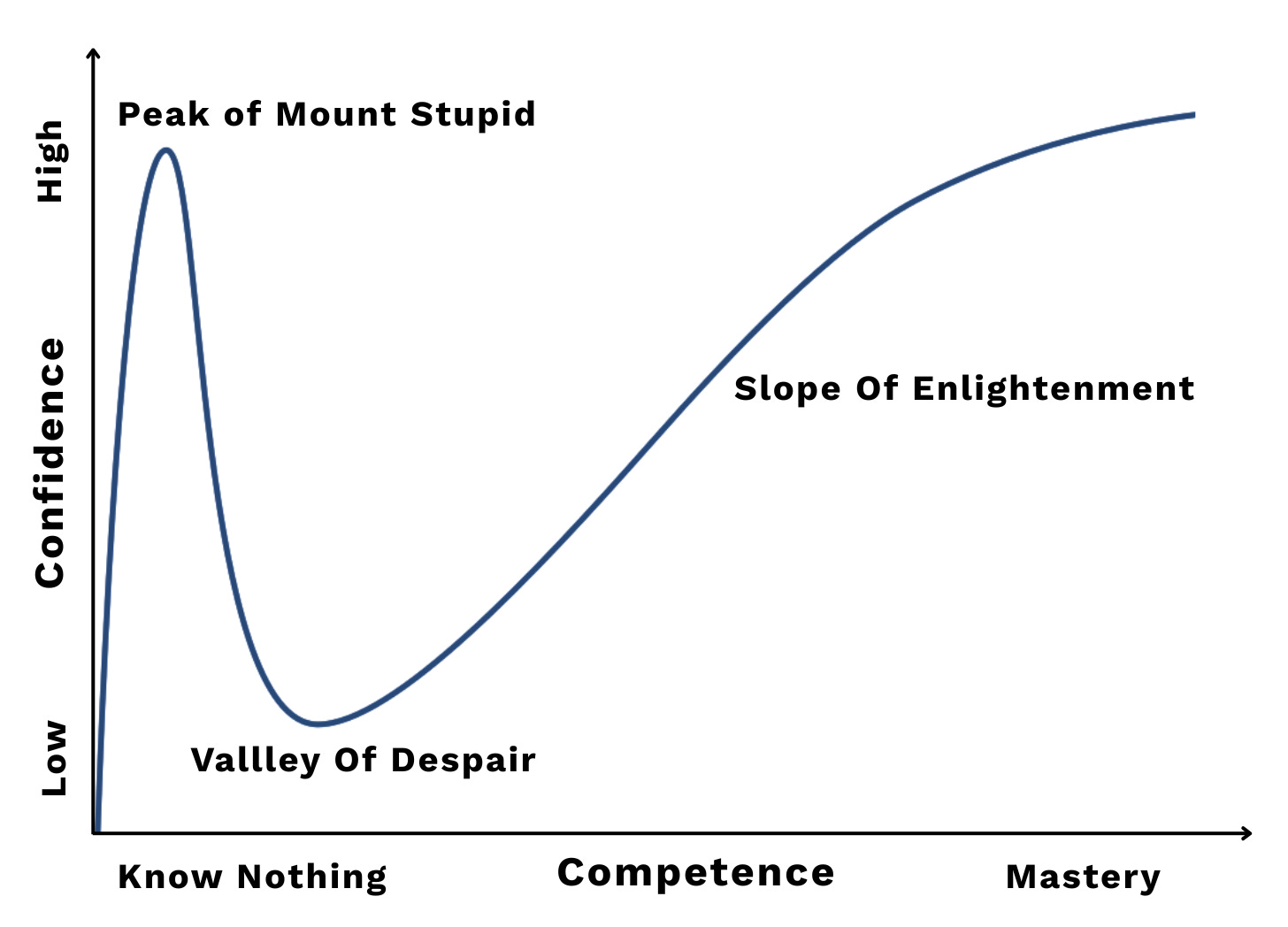
Simulations expose that ignorance before reality does.
.
5. Wrapping Everything Up
The more questions you run, the sharper the picture gets:
What breaks first?
What are my blind spots?
What becomes the choke-point?
What assumptions collapse?
What becomes the obvious next action?
The simulation maps the problem for you. But the map is not the territory.
It won’t predict every tiny detail. It doesn’t need to.
Simulations don’t solve problems. They prevent stupid ones.
Now you have direction.
Reality gives you truth.
Test your move fast, cheap, small.