

How a pioneer of acting helps you build 45-minute attention windows you can use anywhere.
Constantin Stanislavski reshaped acting.
His method seems obvious now (”live your role”) but back then it was a tectonic shift.
I read his work “An Actor Prepares: a few days ago.
The attention part felt like something I’d been doing for years, just sharper, more intentional, and well, a lot better.
.
This is the logic:
Relax → Isolate → Attract → Focus → Flow → Reset
.
1. Relax
“Is it necessary to put so much effort into merely looking?
Less, less! Much less effort! Relax!”
“No one can understand this relief unless he has stood on the open stage crippled with strained muscles.”
Application:
Before any focus work, spend 10–15 seconds removing tension.
→ Loosen the breath
→ Soften the eyes
→ Relax the brow
→ Unclench the jaw
→ Drop the shoulders
Skip this and attention becomes challenge.
Skip this and your focus breaks easier.
Relaxation creates the conditions for attention.
.
2. Solitude In Public
This circle creates solitude in public…you can enclose yourself in it like a snail in its shell.
In this circle you feel entirely alone.
Solitude in public = the skill to focus even when noise, people, screens, pleasure try to seize your senses.
Application:
Create an invisible 70–100 cm circle around you.
Inside: your world.
Outside: not gone, just not your world for now. It’s still there. It waits for you to get out.
If you can fortify yourself here, you can work anywhere.
Takes practice.
Noise-blocking headphones do wonders at first.
.
3. The Interest Magnet
Interest is your magnet to attention.
No interest = Weak attention.
Intellectual attention cannot hold you long. You need something which interests you in the object.
The more attractive the object, the more it will concentrate the attention.
Our brains are wired to chase colors, music, humor, ideas, gossip, dopamine.
If you don’t create a pulling mechanism for your attention, well, something else will.
Think.
What part of this task is interesting?
What story or meaning can you give to this?
Check this AI prompt for more ideas. It is quirky, but gives some fine ideas.
The interesting lever engages your emotion, curiosity, and imagination.
Being interested is far more sustainable than depending on willpower or motivation.
.
4. The Small Circle Of Attention
Your targeting system.
The small circle… is the most essential and practical thing I have learned.”
Start with the nearest object.”
Application:
Pick one physical object in your circle:
- A pen
- Your cup
- A corner of a page
Spend 30–60 seconds observing it.
Color. Texture. Shape. Edges. Reflection.
This is the ignition. Help your mind disconnect from noise.
.
5. Immersion
Observation → tiny action → immersion.
Intensive observation naturally arouses a desire to do something with it… this strengthens the contact.
Application:
Close your eyes.
Recall the details of the object.
This small mental action activates memory and nudges you into the work.
.
6. Flow
Now you start.
As the circle grows larger… if it wavers, withdraw quickly to a smaller circle.
Adjust the circle as needed.
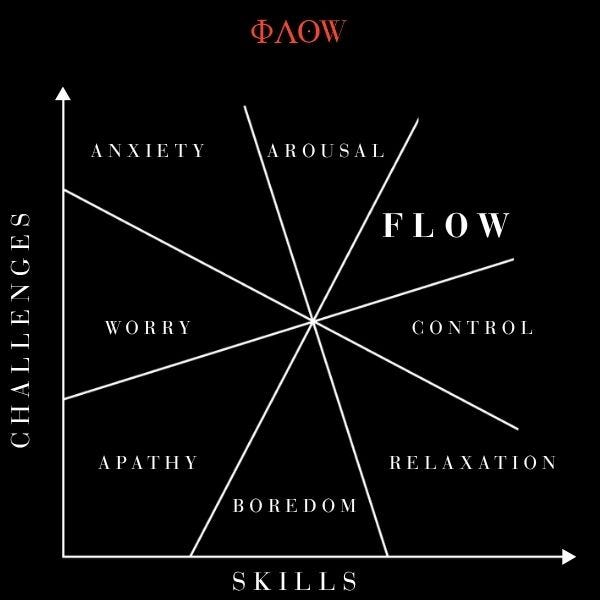
If you feel overwhelm → collapse back to a smaller circle.
If you feel bored → rise to a bigger circle.
This keeps you in the zone where doing the work feels like its own reward.
.
7. Reset Point (If Needed)
When attention slips…redirect it to a single point.
Every time your mind drifts --notification, thought, restlessness-- do a 2-second reset:
1. Look back at the chosen object.
2. Re-enter.
Two seconds are enough to recover your focus.
.
The Full Sequence
00:00–00:15 — Relax
Release muscles, face, breath.
Remove tension so attention becomes possible.
00:15–00:45 — Build Solitude in Public
Create the circle around you and your workspace.
Block the world out.
00:45–01:30 — Ignite Interest
Find the interesting/meaningful hook in the task.
01:30–02:30 — Nearest Object Focus
Examine one object with precision. Texture/shape/color.
02:30–03:00 — Memory Test
Close eyes → recall → immersion begins.
03:00–45:00 — Work
Use circles: small → medium → large. Return to small circle on distraction. Stay inside solitude.
.
Interest keeps attention alive.
Relaxation prevents strain.
You now have an unbroken 45-minute attention window.
Time to flow.
Lifeward,
.
PS
Subscribe to the Daily Problem-Solving Letters.
Join the creators and entrepreneurs who read 3 minutes a day to think clearer, act faster, and live freer.
.
PPS
I’m building something new and better, stay tuned.
But until then, everything from FLOW is free: